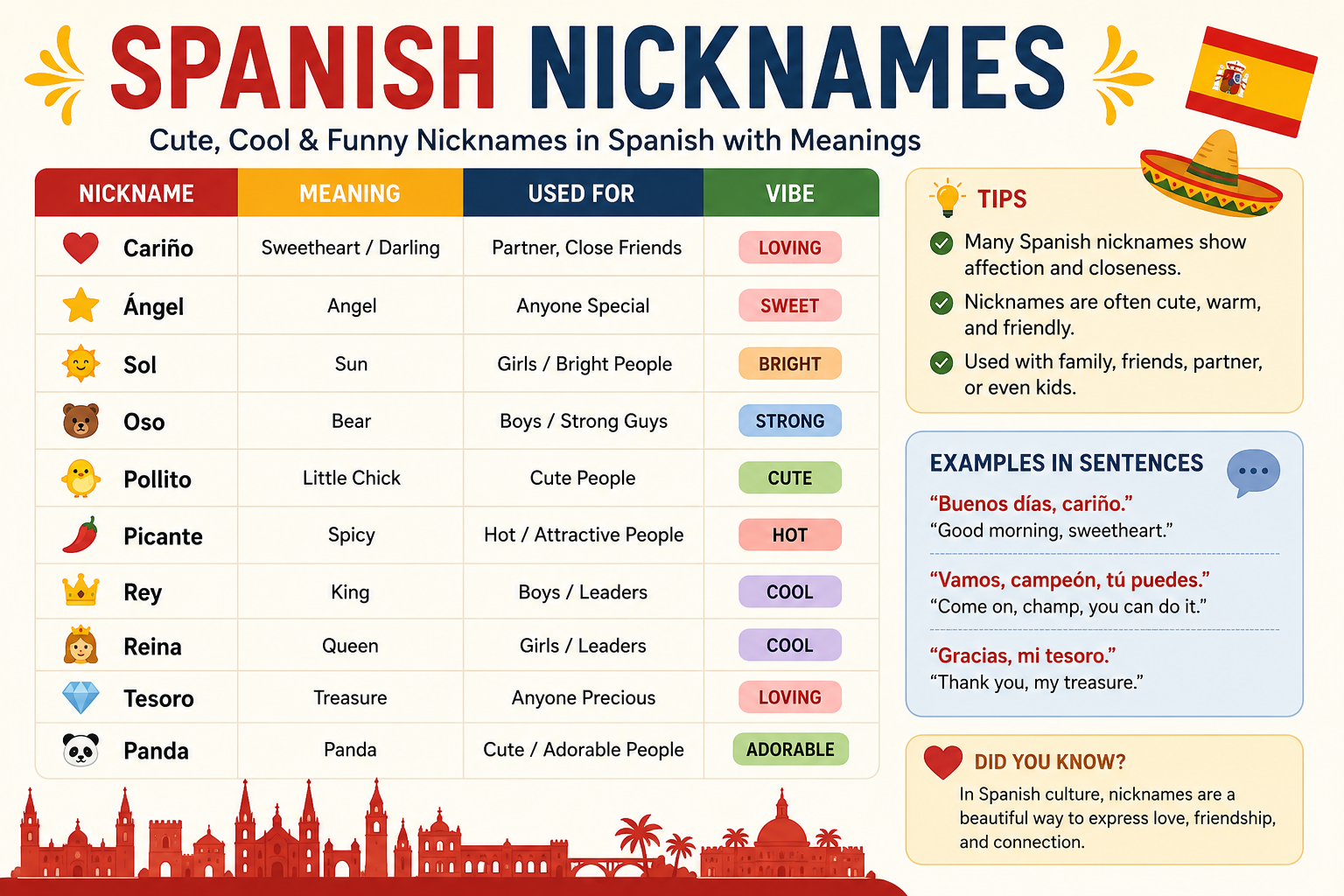
The first time a Colombian friend called me gordo — which literally translates to “fatty” — I genuinely didn’t know whether to laugh or feel offended. I went with laugh, and it turned out to be the right call. He called everyone he liked gordo. It was his way of saying, “you’re one of us.”
That moment taught me something no Spanish class ever did: Spanish nicknames carry a world of warmth, culture, and nuance that you simply can’t learn from vocabulary lists. They’re the difference between speaking Spanish and sounding Spanish.
After exploring hundreds of Spanish nicknames across different countries, relationships, and contexts, I put together this complete guide. Whether you want the right nickname for a partner, a best friend, or a family member — this is the guide I wish I had when I started learning.
Why Spanish Speakers Are So Good at Nicknames
Spanish nicknames, known as apodos, are deeply embedded in everyday Latin and Spanish culture. In English, we have a handful of go-to pet names — babe, honey, sweetie. Spanish speakers, on the other hand, have dozens of layered, context-specific, and often brilliantly funny options for every single relationship in their life.
Moreover, Spanish has a built-in grammatical tool that makes nickname creation almost effortless: diminutives. By adding -ito or -ita to almost any word, you instantly make it smaller, cuter, and more affectionate. Amor (love) becomes amorcito (little love). Beso (kiss) becomes besito (little kiss). It’s like a nickname superpower that comes standard with the language.
In addition, Spanish nicknames vary significantly by region. A term of endearment that sounds perfectly sweet in Mexico City might raise eyebrows in Buenos Aires, and what’s totally casual in Spain might feel oddly intimate in Colombia. Therefore, understanding the context behind each nickname matters just as much as knowing the word itself.
The Sweetest Spanish Nicknames for Romantic Partners
Let’s start with the most popular category — and the one most people actually search for.
Spanish for couples are poetic, passionate, and occasionally delightfully dramatic. I explored a wide range of these and noticed that Spanish-speaking couples tend to use nicknames that express how much a person means to them, not just how they look.
| Spanish Nickname | Literal Meaning | Best Used For |
| Mi amor | My love | Universal romantic partner |
| Cariño | Darling / Affection | Everyday tenderness |
| Mi vida | My life | Deep, committed relationships |
| Corazón | Heart | Romantic partners, close family |
| Cielo | Sky / Heaven | Sweet, romantic relationships |
| Bebé | Baby | Casual couples |
| Querido/a | Dear / Beloved | Romantic and formal affection |
| Tesoro | Treasure | Someone deeply valued |
| Bombón | Chocolate bonbon | Playful, flirty use |
| Pichurri | Cutie | Chile, Peru (romantic partners) |
Mi vida is a personal favorite. Telling someone they are “your life” is genuinely one of the most beautiful things you can say in any language, and in Spanish it rolls off the tongue naturally in daily conversation. Similarly, cielo — literally “sky” or “heaven” — carries a softness that’s hard to match in English.
Corazón is one of those nicknames that crosses over between romance and family easily. You’ll hear it from a grandmother to a grandchild just as often as from a partner whispering across a dinner table.
Spanish Nicknames for Friends — More Fun Than You’d Think
Friendship nicknames in Spanish are where things get genuinely entertaining. Unlike romantic nicknames that lean poetic, friend nicknames often lean playful, teasing, and culturally specific.
I noticed that one of the most fascinating things about Spanish for friends is how physical descriptions get flipped into terms of affection. In many Spanish-speaking cultures, pointing out someone’s physical traits — their weight, height, hair color, nose size — isn’t rude when done within friendship. It’s actually a sign of closeness.
Here are some popular friend nicknames across the Spanish-speaking world:
- Tío/Tía — In Spain, this literally means “uncle/aunt” but functions exactly like “dude” or “man” in English. “¿Qué pasa, tío?” is basically “What’s up, man?”
- Gordo/Gorda — Despite meaning “chubby,” this is one of the most common and affectionate nicknames across Latin America and Spain among close friends.
- Flaco/Flaca — “Skinny one.” Used fondly for a lean friend, completely without malice.
- Güero/Güera — Common in Mexico for a friend with lighter skin or hair. Affectionate, not pointed.
- Loco/Loca — “Crazy one.” A go-to nickname for that one friend who’s always got a wild idea.
- Chamo/Chama — Popular in Venezuela, it’s the equivalent of “dude” or “buddy.”
- Pana — Venezuelan slang for a close friend, similar to “homie” or “pal.”
- Compa — Short for compañero/compañera, meaning companion or buddy. Used across Latin America.
- Primo/Prima — Literally “cousin,” but widely used for close friends who feel like family.
- Hermano/Hermana — “Brother/Sister.” One of the most universal friend nicknames in the Spanish-speaking world.
On the other hand, in Argentina, you’ll hear che used constantly — a uniquely Argentine way of getting someone’s attention, similar to “hey” or “mate.” It’s so distinctly Argentine that Ernesto Guevara was nicknamed Che because he used it so often.
Spanish Nicknames for Family Members — Warm, Layered, and Unforgettable
If romantic nicknames are the poetry of Spanish, family nicknames are the everyday prose — used constantly, passed through generations, and deeply ingrained in how Spanish-speaking families show love.
Mijo/Mija is probably the most iconic of all Spanish family nicknames. It’s a contraction of mi hijo (“my son”) and mi hija (“my daughter”). However, older family members use it for any younger person they feel affection toward — it doesn’t require an actual parent-child relationship. A grandmother might call the neighborhood kid mijo just as naturally.
Other essential family nicknames include:
- Abuelito/Abuelita — Affectionate versions of grandpa/grandma. The diminutive makes it warm and personal rather than formal.
- Mamá/Papá vs. Mami/Papi — The latter versions are softer and more affectionate, used especially by young children (and in some Caribbean countries, between partners).
- Nene/Nena — “Baby boy/Baby girl.” In some families, this nickname sticks well into adulthood.
- Jefe/Jefa — Literally “boss,” used affectionately for the family patriarch or matriarch. There’s a lot of respect embedded in this one.
- Conejito/a — “Little bunny,” a classic nickname for small children that practically melts hearts.
- Gordito/Gordita — The diminutive of gordo. Among family members, it’s 100% affectionate and adorable for babies and toddlers.
- Bebé — Used across ages, from actual babies to adult children whose parents still see them as their little ones.
In my experience, these family Spanish nicknames carry an emotional weight that’s hard to translate directly. When a Spanish-speaking grandmother calls you mija, you feel genuinely claimed and loved.
Funny Spanish Nicknames That Friends Actually Use
Now for the section that Spanish textbooks never include: the funny, slightly absurd nicknames that Spanish speakers absolutely love.
After researching this deeply, I found that humor in Spanish nickname culture often comes from exaggerating physical traits or personality quirks in a way that’s clearly affectionate rather than mean-spirited. The key is the relationship — within a close friendship group, these nicknames are badges of belonging.
| Nickname | Meaning | Used For |
| Cabezón/Cabezona | Big head | Stubborn or literally large-headed friend |
| Pelón/Pelona | Baldy | Someone bald or with very short hair |
| Dormilón/Dormilona | Sleepy one | The friend who’s always napping |
| Bromista | Joker | The group prankster |
| Payaso/Payasa | Clown | The one who’s always making everyone laugh |
| Llorón/Llorona | Crybaby | A sensitive or dramatic friend |
| Vago/Vaga | Lazy one | The friend who avoids all responsibilities |
| Tragón/Tragona | Big eater | The one who finishes everyone’s food |
| Chismoso/Chismosa | Gossip | The one who knows everyone’s business |
| Chiflado/Chiflada | Nutcase | Eccentric, quirky friends |
These Spanish nicknames work because everyone in the group is in on it. As a result, being called pelón by your friends doesn’t sting — it signals that you’re close enough for that kind of teasing.
Regional Spanish Nicknames: Same Language, Different World
One of the things that genuinely surprised me when I explored nicknames across regions was just how differently the same word can land depending on the country.
In Spain: Guapo/Guapa gets used incredibly casually — a shop owner might call a customer guapa as a warm greeting, with zero romantic implication. Tío/Tía for “dude/girl” is everywhere. Majo/Maja means “nice” or “cool” and works as a friendly nickname.
In Mexico: Güero/Güera for lighter-complexioned friends, cuate for a close buddy (derived from the Nahuatl word for twin), and chavo/chava for a young person are all distinctly Mexican.
In Argentina: The vos dialect and che interjection make Argentine Spanish immediately recognizable. Flaco/Flaca and gordo/gorda are common terms of endearment between friends and partners alike, completely stripped of any negative weight.
In the Caribbean (Cuba, Puerto Rico, Dominican Republic): Nene/Nena dominates casual speech. Papi/Mami gets used between partners, between friends, and even by grandmothers talking to grandchildren. Papi chulo adds a layer of attractiveness and admiration to the mix.
Therefore, before you adopt a regional nickname, always listen to how locals actually use it. What’s warm in one country can be awkward — or occasionally inappropriate — in another.
Spanish Nicknames Derived from Real Names
One distinct category of nicknames involves shortening or transforming people’s given names. Spanish has a long tradition of name-based apodos that are completely standard and often used more than the actual name.
Some classic examples:
- Francisco → Pancho / Paco / Curro
- José → Pepe / Che
- Jesús → Chuy / Chucho
- Guadalupe → Lupe / Lupita
- Roberto → Beto
- Manuel → Manolo / Manu
- Ignacio → Nacho
- Alejandro/a → Ale / Alex
- Teresa → Tere
- Mercedes → Meche
Moreover, diminutives attach to these nickname forms too — so Lupita is already a diminutive of Lupe (which is itself a nickname for Guadalupe). Spanish nickname culture works in layers, and the result is an incredibly rich naming tradition that feels deeply personal.
A Quick Guide: Matching the Nickname to the Relationship
| Relationship | Best Spanish Nicknames |
| Romantic partner | Mi amor, cariño, corazón, cielo, mi vida, tesoro |
| Best friend | Hermano/a, primo/a, compa, loco/a, tío/tía (Spain) |
| Young child | Mijo/mija, nene/nena, gordito/a, conejito/a |
| Grandparent → grandchild | Mijo/mija, corazón, bebé |
| Playful/funny | Gordo/a, flaco/a, loco/a, dormilón/a, bromista |
| Colleague (casual) | Compa, amigo/a, jefe/jefa |
Quick Tips Before You Start Using Spanish Nicknames
Before you jump in, here are a few things I personally tested and learned the slightly awkward way:
- Always follow the lead of locals. If someone uses a nickname with you first, it’s safe to use it back. If you’re unsure, start with the universally safe ones: amigo/amiga, hermano/hermana, cariño for a partner.
- Diminutives are your best friend. When in doubt, adding -ito or -ita to almost anything makes it instantly warmer and more affectionate.
- Context is everything. Gordo from your best friend = love. Gordo from a stranger = probably not okay.
- Regional research matters. Spend five minutes understanding which country’s Spanish you’re engaging with before pulling out a nickname you read online.
- Tone carries the meaning. Many Spanish nicknames work entirely because of how they’re said, not just what they mean.
FAQs About Spanish Nicknames
Q1. What are the most common Spanish nicknames for a girlfriend or boyfriend?
The most commonly used Spanish nicknames for romantic partners include mi amor (my love), cariño (darling), corazón (heart), cielo (sky/heaven), and bebé (baby). For something playful, bombón and chulo/chula work well in casual relationships.
Q2. Is gordo/gorda really used as a term of affection in Spanish?
Yes, genuinely. Among close friends, family members, and even couples across Latin America and Spain, gordo/gorda is a warm, playful nickname with no negative intent. Context and tone determine everything.
Q3. What do Spanish speakers call their close friends?
Common friend nicknames in Spanish include hermano/hermana (brother/sister), compa (buddy), primo/prima (cousin), loco/loca (crazy one), and tío/tía (dude/girl — mainly in Spain). Regional terms like pana (Venezuela) and cuate (Mexico) are also widely used.
Q4. How do diminutives work in Spanish nicknames?
Adding -ito to masculine nouns or -ita to feminine nouns makes any word cuter and more affectionate. For example, amor → amorcito, beso → besito, loco → loquito. It’s one of the most versatile tools in Spanish nickname culture.
Q5. Are Spanish nicknames based on physical appearance offensive?
Within close relationships, physical nicknames like flaco (skinny), gordo (chubby), güero (light-skinned), or pelón (bald) are typically affectionate and completely normal. They signal familiarity, not cruelty. However, using them with strangers or acquaintances is a different matter entirely.
Q6. What Spanish nicknames work across all regions?
The safest, most universally understood Spanish nicknames are mi amor, cariño, amigo/amiga, hermano/hermana, mijo/mija, and corazón. These cross regional and cultural boundaries without ambiguity.
Q7. What does mijo mean and can anyone use it?
Mijo is a contraction of mi hijo (my son), and mija means mi hija (my daughter). While parents use these for their actual children, older adults routinely use them for any younger person they feel fondness toward. It’s one of the warmest and most widely used Spanish nicknames across all of Latin America.
Final Thoughts — Nicknames Are Where Spanish Comes Alive
Learning Spanish vocabulary is one thing. Learning Spanish nicknames is where the language actually comes alive.
The moment you call a close friend hermano with the right energy, tell a partner mi vida in a quiet moment, or affectionately call your abuelita abuelita — you’re not just using words. You’re participating in a cultural tradition of warmth, humor, and human connection that runs through every Spanish-speaking country in the world.
Finally, don’t overthink it. The beauty of Spanish nicknames is that they grow naturally out of relationships. Start with one or two that feel right, pay attention to how people around you use them, and let the rest follow. Before long, you’ll find yourself reaching for cariño and hermano without even thinking about it — and that’s when you know the language has really gotten under your skin.