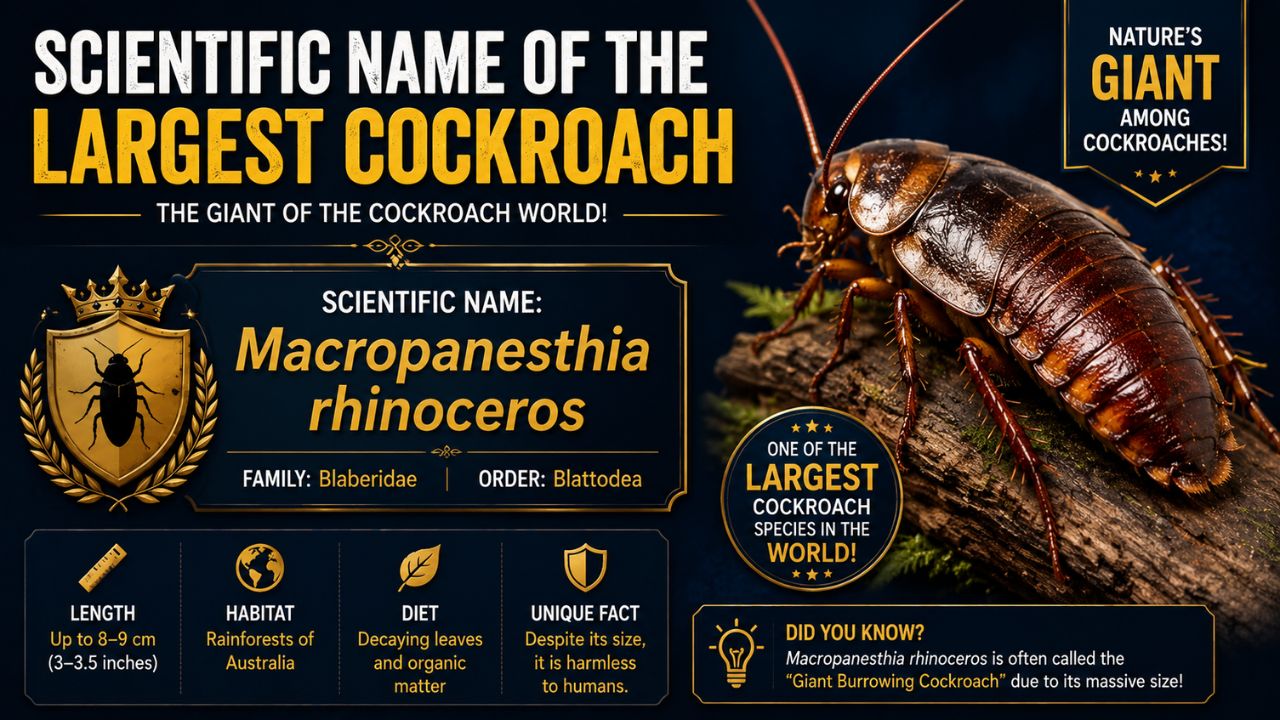
When people hear the word “cockroach,” they usually imagine a small household pest running across the floor. However, the cockroach family is far more diverse than most people realize. Some species are surprisingly beautiful, some can fly long distances, and a few grow to astonishing sizes. This often leads curious readers to search for the scientific name of the largest cockroach and learn more about these fascinating insects.
After researching this deeply, I discovered that the title of the world’s largest cockroach can actually depend on whether you’re measuring length, weight, or wingspan. Nevertheless, one species consistently stands out in scientific discussions and wildlife records.
In this guide, we’ll explore the scientific name of the largest cockroach, its habitat, size, characteristics, life cycle, and some incredible facts that make it one of the most fascinating insects on Earth.
Meet the World’s Biggest Cockroach
The scientific name of the largest cockroach by weight is:
Macropanesthia rhinoceros
This species is commonly known as the:
- Giant Burrowing Cockroach
- Rhinoceros Cockroach
- Queensland Giant Cockroach
Unlike the common household cockroach, this enormous insect is harmless, slow-moving, and plays an important role in its ecosystem.
Quick Facts Table
| Feature | Details |
| Scientific Name | Macropanesthia rhinoceros |
| Common Name | Giant Burrowing Cockroach |
| Family | Blaberidae |
| Maximum Length | Up to 8 cm (3.1 inches) |
| Maximum Weight | Up to 35 grams |
| Lifespan | Up to 10 years |
| Native Region | Queensland, Australia |
| Diet | Dead leaves and plant material |
| Wings | Wingless |
The scientific name of the largest cockroach is frequently mentioned in zoological studies because this species is significantly heavier than most other cockroaches found worldwide.
Why This Cockroach Holds the Record
Many people assume that the longest cockroach must automatically be the largest. However, scientists classify size using multiple measurements.
Largest by Weight
The Giant Burrowing Cockroach is considered the heaviest cockroach ever recorded.
Largest by Wingspan
Some tropical species may have a larger wingspan.
Largest by Length
Certain giant tropical roaches can be slightly longer.
However, when overall mass and body size are considered together, Macropanesthia rhinoceros remains the strongest contender for the title.
Therefore, when someone asks for the scientific name of the largest cockroach, this species is usually the correct answer.
A Closer Look at the Giant Burrowing Cockroach
One reason this insect fascinates researchers is its unusual appearance.
Unlike typical cockroaches:
- It cannot fly.
- It does not infest homes.
- It spends most of its life underground.
- It moves slowly.
- It feeds mainly on dead leaves.
I noticed that many people fear cockroaches because of their association with urban pests. However, this species behaves very differently from the roaches commonly found in kitchens and buildings.
In fact, it acts more like a tiny underground recycler than a household pest.
Where Does the Largest Cockroach Live?
The scientific name of the largest cockroach belongs to a species native to Australia.
Primary Habitat
The Giant Burrowing Cockroach lives in:
- Queensland grasslands
- Open forests
- Woodland ecosystems
- Areas with sandy soil
These insects create underground tunnels that may reach depths of:
- 1 meter (3 feet) or more
The burrows provide protection from:
- Predators
- Heat
- Drought
Meanwhile, the underground environment helps maintain stable temperatures throughout the year.
Incredible Size Comparison
Many people wonder just how large this cockroach really is.
Let’s compare it with common species.
| Cockroach Species | Average Length |
| German Cockroach | 1.5 cm |
| American Cockroach | 4 cm |
| Madagascar Hissing Cockroach | 6–7 cm |
| Giant Burrowing Cockroach | Up to 8 cm |
Although the difference may not sound dramatic on paper, the Giant Burrowing Cockroach is far heavier and bulkier than most other species.
As a result, it appears much larger in real life.
The Fascinating Life Cycle
One reason scientists admire this insect is its unusually long lifespan.
Most cockroaches live:
- Several months
- Up to two years
However, the Giant Burrowing Cockroach can survive for nearly:
10 Years
This makes it one of the longest-living cockroach species known.
Life Stages
- Egg
- Nymph
- Adult
Unlike butterflies, cockroaches do not undergo complete metamorphosis.
Instead, young nymphs gradually resemble adults after each molt.
Why Scientists Study This Species
The scientific name of the largest cockroach frequently appears in biological research because it offers valuable insights into insect evolution.
Researchers study it for:
- Burrowing behavior
- Ecosystem contributions
- Insect longevity
- Adaptation to dry climates
- Social behavior
Moreover, its underground lifestyle provides clues about how insects survive extreme environmental conditions.
Nature’s Cleanup Crew
One surprising fact about this species is its environmental importance.
The Giant Burrowing Cockroach feeds primarily on:
- Fallen leaves
- Decaying vegetation
- Organic debris
Therefore, it helps recycle nutrients back into the soil.
Without decomposers like this cockroach:
- Dead plant matter would accumulate.
- Soil fertility would decrease.
- Ecosystem balance could suffer.
In my experience, learning about insects often changes how people view them. Once you understand their ecological role, they become far more interesting than frightening.
Largest Cockroach vs Madagascar Hissing Cockroach
Many people confuse these two famous species.
Here’s a simple comparison.
| Feature | Giant Burrowing Cockroach | Madagascar Hissing Cockroach |
| Scientific Name | Macropanesthia rhinoceros | Gromphadorhina portentosa |
| Weight | Up to 35 g | Around 20–25 g |
| Wings | None | None |
| Habitat | Australia | Madagascar |
| Lifespan | Up to 10 years | 3–5 years |
| Burrowing | Yes | No |
| Hissing Sound | No | Yes |
Although the Madagascar Hissing Cockroach is famous, it is not generally considered the world’s largest by weight.
Surprising Facts About the Largest Cockroach
1. It Can Live for a Decade
Very few insects survive this long.
2. It Doesn’t Fly
Despite its size, it has no wings.
3. It Rarely Encounters Humans
Most individuals spend their lives underground.
4. It Helps Improve Soil Quality
Its feeding habits support nutrient recycling.
5. It Is Completely Harmless
It does not bite, sting, or spread household infestations.
Other Giant Cockroach Species Around the World
Although Macropanesthia rhinoceros is often recognized as the answer to the scientific name of the largest cockroach question, several other giant species deserve attention.
Megaloblatta longipennis
Known for:
- Huge wingspan
- Length exceeding 9 cm in some cases
Madagascar Hissing Cockroach
Known for:
- Loud hissing sounds
- Popularity in insect exhibits
Blaberus giganteus
Known for:
- Impressive flight ability
- Large body size
However, the Giant Burrowing Cockroach remains the heavyweight champion.
Can You Keep One as a Pet?
Surprisingly, yes.
Some insect enthusiasts keep Giant Burrowing Cockroaches as pets.
Reasons include:
- Long lifespan
- Low maintenance
- Unique appearance
- Interesting behavior
However, they require:
- Proper humidity
- Suitable substrate
- Adequate space for burrowing
I explored several exotic pet communities and noticed that many owners describe them as calm, easy-to-care-for insects.
Common Myths About Giant Cockroaches
Myth 1: All Cockroaches Spread Disease
Not true.
Wild species like the Giant Burrowing Cockroach rarely come into contact with human food.
Myth 2: They Attack Humans
False.
These insects are harmless.
Myth 3: They Can Fly
This species is wingless.
Myth 4: Bigger Means More Dangerous
In reality, the largest cockroach is among the least threatening.
Why Interest in the Scientific Name of the Largest Cockroach Is Growing
Searches for the scientific name of the largest cockroach have increased due to:
- Wildlife documentaries
- Social media videos
- Educational YouTube channels
- School science projects
- Curiosity about giant insects
Moreover, unusual animal records always attract attention online.
People naturally want to know which species holds the title of “largest.”
Final Thoughts
The answer to the question scientific name of the largest cockroach is Macropanesthia rhinoceros, a remarkable insect that challenges many common assumptions about cockroaches. Instead of being a household pest, it is a gentle giant that spends its life underground, recycling organic matter and supporting healthy ecosystems.
After researching this deeply, I found that this species is one of the most fascinating insects in the world. Its impressive size, decade-long lifespan, and unique burrowing behavior make it stand out among thousands of cockroach species.
Therefore, the next time someone asks about the scientific name of the largest cockroach, you’ll know it’s not just a giant bug—it’s an extraordinary part of nature’s recycling system and one of the most unique insects on the planet.